“The supplier gave us a true one-stop parts solution. Their team matched the right Caterpillar, Perkins, and filter parts for our equipment, and the support stayed fast and professional from inquiry to delivery.”
How the Genuine CAT 418-5941 Gas Spring Works in CAT Track Loaders
Small part. Big consequence. I have seen too many fleets treat a cab-door strut like bargain-bin hardware, even though CAT identifies the CAT 418-5941 gas spring as an 830 mm long poly cab door gas spring built to control opening and closing, and the underlying gas-spring mechanics are brutally sensitive to force, damping, seal condition, and geometry once real dust, vibration, and operator abuse enter the picture. Why pretend this is just trim?
Spis treści
What the CAT 418-5941 gas spring actually is
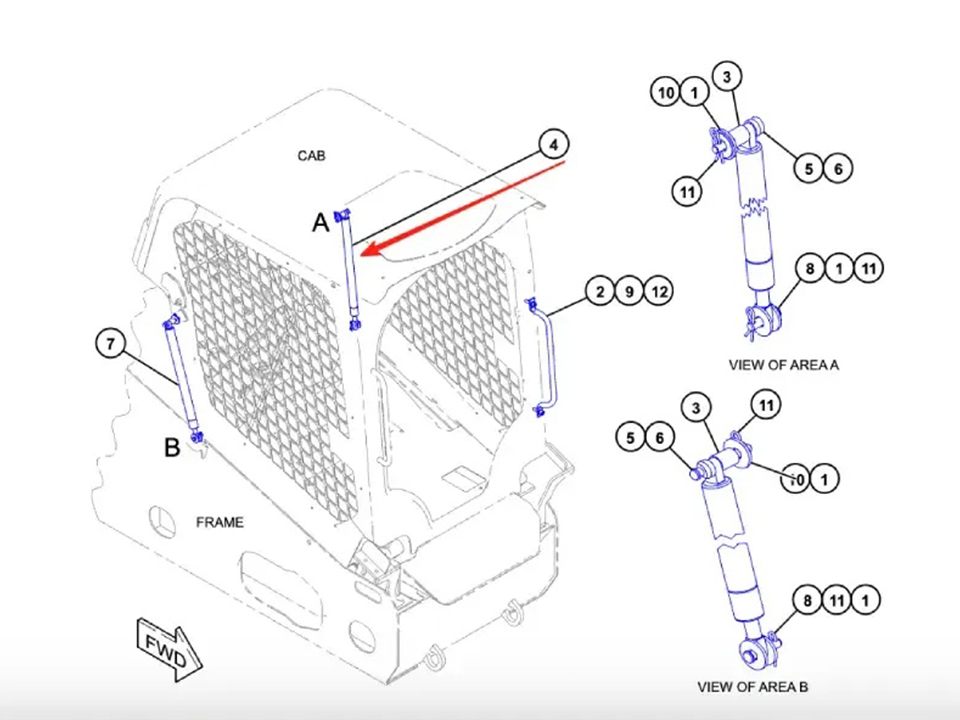
Here is the plain version. The 418-5941 gas spring assembly is a genuine CAT door-support component, not a generic stick with two ends; CAT’s own catalog language ties it directly to poly cab door opening and closing, which tells you the part’s job is controlled motion, not mere lift assistance. That distinction matters because doors fail at the hinge, latch, and operator interface long before people admit the strut is the root cause.
And this is where most aftermarket copy gets lazy. SUSPA, a major gas-spring manufacturer, explains that gas springs are hydropneumatic units filled with nitrogen and oil, that extension force is generated by pressure acting on the piston-rod area, and that damping and friction materially change motion; it also notes fill pressures can range from 10 to 230 bar depending on geometry, with oil handling lubrication and end-position damping. CAT does not publish the internal fill pressure for 418-5941 on the retail page, but the OEM description maps cleanly onto that operating principle. That is not marketing poetry. That is physics.
How the pressure, rod geometry, and damping do the real work
This is the mechanism. Compressed N₂ pushes the piston rod outward, the rod-side area difference creates usable extension force, and the oil inside the cylinder slows the motion so the CAT poly cab door gas spring does not fling the door open or let it collapse shut with that cheap, ugly shock operators know too well. Ever wonder why a worn strut can feel “fine” in the middle of travel and terrible at the ends?
Because end behavior tells the truth. SUSPA’s technical notes point out that friction, damping resistance, installation position, side loading, scratches on the rod, vibration, and temperature all affect performance and service life; it gives a broad durability band of 10,000 to 100,000 double strokes, then immediately warns that real application conditions decide the actual result. That is the hard truth I trust: the lab number is not your dirt lot.
CAT’s own fitment trail says more than most sellers do
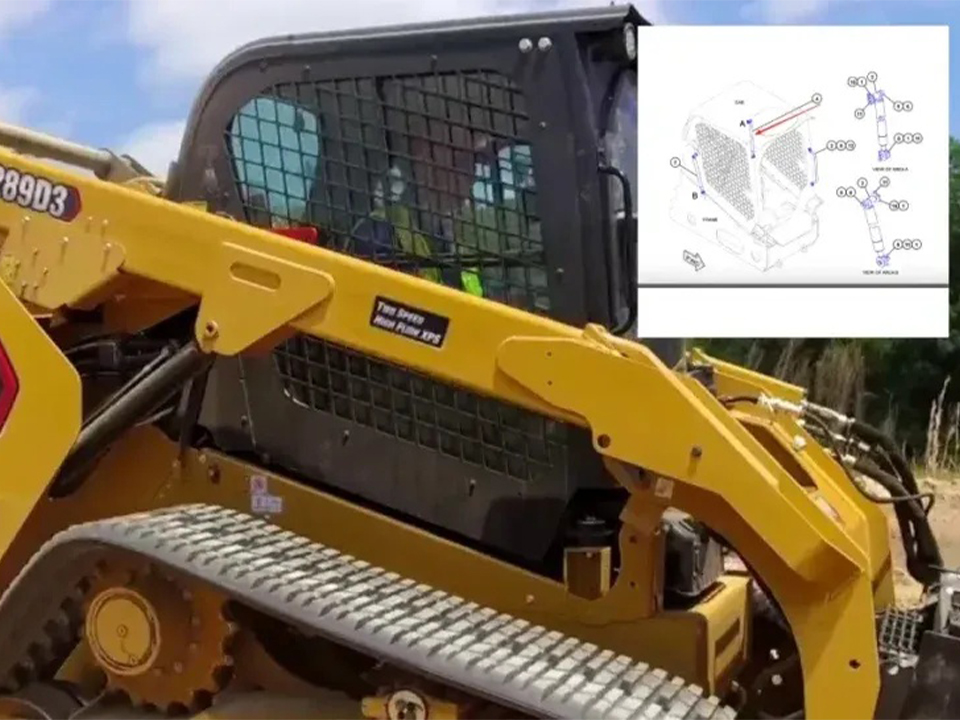
I like documents. I trust them more than catalog adjectives. Across current CAT front-door pages, the CAT track loader cab door gas spring shows up not once, but repeatedly, and the pattern is consistent: the door assemblies specify two 418-5941 springs and CAT marks those assemblies as Factory Fit to named loader families.
CAT door page
Door type
418-5941 quantity
Track loader families shown
581-9104
Polycarbonate front door
2
239D, 239D3, 249D, 249D3, 299D2, 299D2 XHP, 299D3, 299D3 XE; 297D2 and 297D2 XHP multi terrain loaders
That table is not trivia. It is the real answer to the CAT 418-5941 compatible models question: CAT itself ties the spring to multiple compact and multi terrain loader door systems, especially the D, D2, and D3 families listed above, and it does so in complete door assemblies where kinematics, hinge points, striker positions, and spring quantity are already engineered as a package.
Genuine versus “fits CAT”: my unpopular opinion
I will say it bluntly. The market lies by omission. A seller can match eyelet spacing and still miss spring force, friction, damping profile, corrosion protection, or rod finish, and once that happens the door may still open, but it no longer opens correctly; instead it starts loading hinges, pins, and latches in ways operators normalize until a larger failure arrives. That is why I do not treat a genuine CAT gas spring and a vague “replacement” as equivalent products unless the substitute publishes real engineering data.
The safety culture around “cheap parts” is worse than people admit. In October 2024, the UK Intellectual Property Office said one in six surveyed motorists had bought a counterfeit vehicle part in the prior 12 months, 58% said they had done so knowingly, 31% cited lower price, and among those counterfeit purchases 14% involved airbags while 12% involved brake pads or discs; the same release said officers had recently seized 500 counterfeit airbags. That is not the same component as a loader door strut, no, but the buying psychology is identical: low price first, consequences later.
And the criminal side is not hypothetical. In March 2024, the U.S. Department of Justice said a Memphis mechanic pled guilty after importing counterfeit airbag parts from China, assembling fake airbags, selling about 533 of them for roughly $100 to $725 each, and prompting agents to recover more than 2,000 counterfeit airbags and parts. Once you have read that, the phrase “good enough replacement” should stop sounding clever.
What failure looks like before the part fully dies
First the feel changes. Then the behavior changes, and then the hardware bill arrives, because a weak CAT compact track loader gas spring usually announces itself with a door that rises unevenly, hesitates near the top, refuses to hold open with authority, or starts slamming energy into the hinge and latch instead of dissipating it through controlled motion. That is the point where many operators still call the spring “usable.” I call it borrowed time.
The broader safety context should make that sting a little more. BLS data released in December 2024 showed the U.S. construction sector recorded 1,075 fatal occupational injuries in 2023, including 421 from falls, slips, and trips and 148 from contact incidents, while OSHA continues to describe construction as a high-hazard industry that includes exposure to being struck by heavy construction equipment and unguarded machinery. A door strut is not a rollover protection system, obviously, but in high-hazard work, I do not dismiss any component that controls motion next to the operator.
The maintenance mistake nobody budgets for
Tiny neglect. Expensive pattern. If your team already understands the value of disciplined service parts on the engine side, whether that means a Perkins 2654403 oil filter, a Perkins 4759205 fuel filter, lub Perkins SE573/1 thermostat, then you already understand the real lesson here: uptime is usually lost through “small” parts that procurement people think are interchangeable.
And resale buyers notice. The same small-component discipline that shapes buyer confidence in a used CAT 352 excavator also shapes how professionals read a compact loader: if the door hardware feels tired, sticky, or improvised, they assume the unseen maintenance story is worse.
FAQ
How does CAT 418-5941 gas spring work?
The CAT 418-5941 gas spring is an 830 mm OEM door strut that uses compressed nitrogen and oil damping to open, support, and slow the poly cab door on compatible Cat loaders, so the operator gets controlled motion instead of a door that swings, sags, or drops unexpectedly. That is the short answer; the longer answer is that rod area, friction, and damping determine whether the door feels precise or worn out.
What are the documented CAT 418-5941 compatible models?
CAT 418-5941 compatible models are the loaders whose CAT front-door assemblies list this spring as a factory-fit component, including documented CTL and MTL families such as 239D, 249D, 259D, 279D, 289D, 299D, several D2 and D3 variants, and related multi terrain loader door-kit configurations where two springs are specified. The exact fitment depends on the door assembly, not just the machine badge, which is why CAT’s kit pages matter.
When should you plan a CAT gas spring replacement?
A CAT gas spring replacement is due when the door no longer rises smoothly, loses holding force near full open, shows oil leakage, develops corrosion or rod scoring, or begins transferring extra shock into hinges, pins, and the latch instead of absorbing motion the way the original spring should. Waiting for total failure is the lazy way to maintain door hardware, and it usually shifts the cost into adjacent parts.
Is a genuine CAT gas spring really better than a generic substitute?
A genuine CAT gas spring is the OEM-spec strut built to the door’s intended dimensions, force behavior, and damping profile, while many “fits CAT” substitutes may match mounting points yet miss extension force, friction, or end-of-stroke control, which is exactly where operators start feeling the difference in daily use. My view is simple: if the alternative seller cannot document force and fitment at the same level CAT documents the assembly, I do not call it equivalent.
If you are publishing parts content around this topic, do not settle for soft copy. State the length, the documented fitment, the role in the door system, and whether you are talking about a 418-5941 gas spring assembly that is genuinely CAT or merely close enough to fool a thumbnail photo, because professionals can smell filler copy instantly.