“The supplier gave us a true one-stop parts solution. Their team matched the right Caterpillar, Perkins, and filter parts for our equipment, and the support stayed fast and professional from inquiry to delivery.”
Most shops guess. When I hear someone reduce a Komatsu final drive assembly to “just the travel motor and some gears,” I already know where the bill is going: repeat downtime, metal in the oil, wrecked seals, a warranty argument, and a machine owner forced to relearn the oldest lesson in iron ownership, which is that cheap bench work is often premium-priced failure wearing a discount tag. Why do we keep pretending this is bad luck?
I’ll say the quiet part out loud. A failed final drive rebuild is rarely one dramatic mistake; it is usually five boring mistakes stacked together—dirty assembly surfaces, reused hardware, damaged seal lips, guessed torque, and zero respect for oil cleanliness or lockout discipline. That attitude has consequences well beyond the invoice: OSHA’s lockout/tagout rule still centers on preventing hazardous energy release during service, a March 18, 2024 Washington FACE report documented a 36-year-old mechanic who died while repairing a large excavator, and BLS reported 5,283 fatal occupational injuries in 2023, including 779 contact incidents.
Table of Contents
What a Komatsu final drive assembly actually is
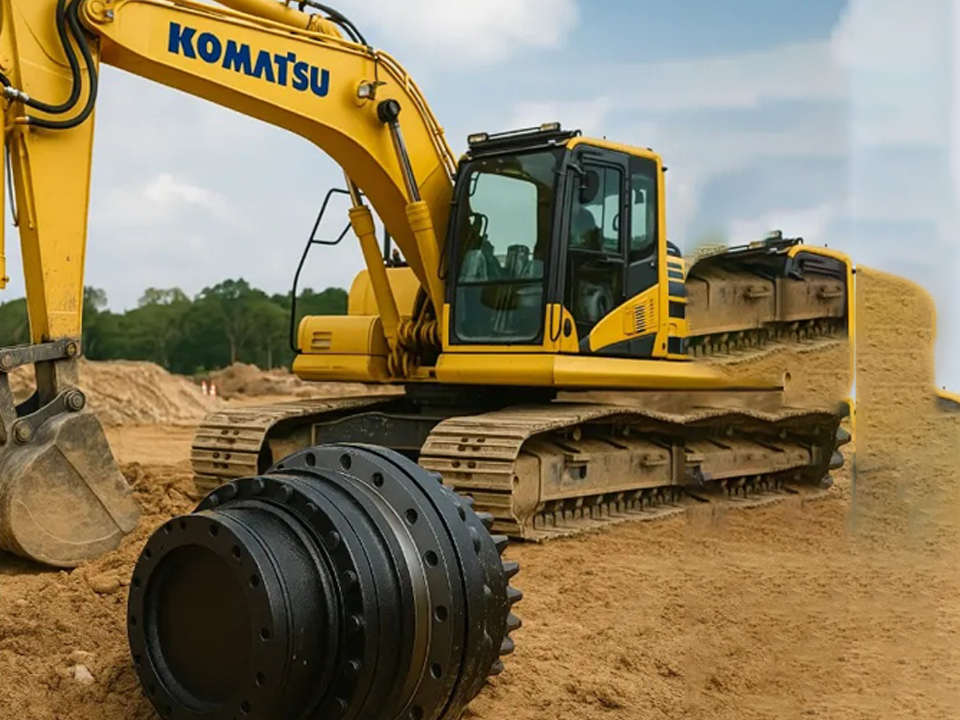
It is not a mystery box. It is the track-end reduction system that takes hydraulic motor output and turns it into slow, brutal torque at the sprocket, and Komatsu’s own equipment literature keeps repeating the same design priorities for a reason: hydrostatic travel, planetary or double-reduction final drives, protective sealing, and filtration that exists to keep abrasive debris out before wear turns expensive. On current Komatsu documents you can see references to planetary gear type final drives, triple labyrinth final drive seals, O-ring face seals, and high-pressure in-line filtration, which tells you exactly what the engineers are worried about.
And this is where sloppy diagnosis starts. If you call everything a “travel motor problem,” you miss the difference between hydraulic weakness, bearing fatigue, seal failure, case damage, carrier wear, and planetary gear damage; those are not the same repair, not the same parts list, and definitely not the same warranty risk. I’ve seen fleets obsess over acquisition price while ignoring ownership logic that becomes obvious the moment you study broader equipment value, the same way buyers do when comparing used Cat 352 excavator ownership math.
Why most rebuilds fail before the first full week
Contamination wins first. Shops love to talk about broken teeth because snapped metal looks dramatic in a WhatsApp photo, but the more common killer is quieter—silica dust on the bench, dirty oil passages, a seal installed dry, a bearing not fully seated, or a housing that was never cleaned well enough to deserve reassembly in the first place. Who gets blamed later? The part, usually.
Komatsu’s own published design cues back that up. Triple labyrinth seals, O-ring face seals, and in-line filtration are not cosmetic features; they are admissions, in plain engineering language, that dirt ingress and fluid contamination destroy service life long before a brochure-friendly failure mode ever appears.
The repair-or-replace math nobody says aloud
Downtime lies badly. A rebuild quote can look smart at 8:00 a.m., but by the time the machine misses hauling windows, site sequencing slips, and the operator starts nursing a weak side travel condition that should have been fixed properly the first time, the “budget” choice has turned into a productivity tax that keeps compounding after the invoice is paid. Still want the cheapest number on paper?
There is also a wider industry fight here, and it is not imaginary. Reuters reported on October 17, 2024 that the U.S. Federal Trade Commission was probing Deere over repair restrictions, a reminder that machine repair is increasingly about access to tools, diagnostics, and control over the service channel, not just mechanical skill at the bench. That matters because owners choosing between a Komatsu final drive rebuild guide, a field repair, and the best Komatsu final drive replacement are operating inside a market where information, parts quality, and repair access are uneven by design.
So here is my bias. If the housing is clean, the hard parts inspect well, the bearing fits are still honest, and the shop can document measurement, cleanliness, and preload, then a rebuild can make sense. But if the case is scored, the hub fit is questionable, the oil was glittering, or the machine earns real money every day, I stop romanticizing rebuilds and start leaning toward replacement or a reman unit with traceable testing.
Decision path
Best fit
Main upside
Main trap
What I would demand before approval
In-house rebuild
Fleet with proven clean bench process and measuring tools
Lowest immediate cash outlay
Hidden contamination and assembly error
Photos, measurements, replaced wear parts list, oil flush record
Outsourced reman
Owner wants balance between cost and speed
Better process control than ad hoc repair
Mixed quality between suppliers
Test report, warranty terms, serial match, seal and bearing spec
New replacement assembly
High-value machine or repeated failure history
Fastest path to predictable uptime
Highest upfront price
OEM or verified supplier traceability, exact model/serial fitment
The checks that separate a real assembly job from theater
I do not trust glossy words. I trust evidence: housing condition, shaft and bearing fit, carrier face condition, ring gear seating, seal installation method, hose cleanliness, oil fill discipline, and a first-run inspection that looks for heat, noise, leakage, and metal immediately instead of after the machine goes back to production.
Specifics matter. Komatsu literature for large excavators lists examples such as hydrostatic travel systems, planetary reduction architectures, and even published final drive lubricant capacities; on the PC1250 family, Komatsu lists 21 liters per side for final drive oil, which is a nice reminder that lubricant volume is not an afterthought but part of the system’s survival budget. Ignore oil level, fill the wrong lubricant, or skip the first contamination check, and you are not maintaining a final drive—you are testing how fast it can fail.
And here is the industry irritation nobody likes hearing: many “how to assemble a Komatsu final drive” articles are really sales pages in overalls. They show parts. They rarely show bench cleanliness, measuring procedure, seal protection, break-in checks, or the unpleasant moment when a technician has to reject a reusable-looking component because it is not actually reusable. I would rather lose a sale than ship a comeback.
What I would inspect before approving a Komatsu final drive assembly
If I were signing the work order, I would ask for four things before first track movement. First, proof that the housing and geartrain were cleaned to assembly standard, not shop-floor standard. Second, confirmation that seals, bearings, and worn thrust surfaces were replaced rather than “judged okay.” Third, documentation of torque procedure and fit checks. Fourth, immediate post-install oil inspection after controlled running time. That is the boring work that keeps the machine alive.
And no, I do not separate that mentality from the rest of machine care. Shops that keep tight habits on filtration, cooling, and contamination across the machine usually build better final drives because they already understand that tiny particles, fluid condition, and temperature are not side issues; they are the story.
FAQs
What is a Komatsu final drive assembly?
A Komatsu final drive assembly is the complete track-drive reduction unit that combines the hydraulic travel motor, reduction gears, bearings, seals, hub, and housing to convert hydraulic flow into slow, high-torque sprocket rotation, and Komatsu literature ties that function directly to hydrostatic travel systems, planetary reduction, and protective sealing features.
In plain English, it is the part that makes track motion usable under load. When it is weak, noisy, leaking, or contaminated, the machine does not just lose travel efficiency; it starts burning time, money, and confidence.
How do I decide between a Komatsu final drive rebuild and a full replacement?
A rebuild is usually the right call when the housing, hub, and major hard parts remain dimensionally sound and the damage is limited to bearings, seals, or selected gears, while a full replacement makes more sense when contamination is severe, the case is worn, the assembly has repeated failure history, or downtime costs more than the labor savings.
That is why I look at earning capacity before I look at quote price. Cheap work on a low-use machine can survive. Cheap work on a production machine can poison the week.
Can I assemble a Komatsu final drive in-house?
You can assemble a Komatsu final drive in-house only if the shop can prove bench cleanliness, correct measuring tools, seal installation discipline, controlled torque procedure, safe machine isolation, and post-assembly inspection, because most failures begin with contamination and hazardous-energy shortcuts rather than dramatic gear breakage.
I’m not against in-house work. I’m against fantasy. If your bench process is dirty, undocumented, and improvised, the assembly does not belong back on the machine.
What is the biggest mistake in excavator final drive assembly?
The biggest mistake in excavator final drive assembly is treating the unit like a simple gear case instead of a sealed hydraulic-mechanical system, which leads technicians to underweight oil cleanliness, seal integrity, bearing fit, housing condition, and safe isolation before the first startup.
That mindset creates the classic comeback job: the rebuild that looks fine on the pallet, sounds fine for an hour, and then leaks, heats up, or sheds metal because the real failure was introduced at assembly, not in service.
If your machine is already leaking, pulling, grinding, or dropping metal into the drain oil, stop buying blind. Match the assembly by model, serial range, travel system spec, seal design, and failure evidence, then demand documentation before the first bolt turns; that is how you avoid paying twice for the same Komatsu final drive problem.