“The supplier gave us a true one-stop parts solution. Their team matched the right Caterpillar, Perkins, and filter parts for our equipment, and the support stayed fast and professional from inquiry to delivery.”
How to Choose the Correct CAT 3304/3306 Piston: Supplier Guide for Importers, Dealers & Distributors
Most CAT 3304/3306 piston mistakes aren’t born in the workshop, or at customs, or even after installation; they usually begin in a dull email thread where somebody approves a quote using only “3304/3306 piston” as the reference, ignores arrangement details, skips the ring-land and pin-fit questions, and gets hypnotized by a tidy unit price. Then the comeback hits. Hard.
But that’s the trade, isn’t it?
I frankly believe too many importers and dealers are still buying pistons like they’re buying phone cases. Same photo, same label, same promise. Ship it. From my experience, that’s exactly how you end up with bad crown geometry, off-spec groove width, mixed-batch kits, and the kind of warranty fight that eats your margin one annoyed customer at a time.
Table of Contents
The market doesn’t punish ignorance immediately
That’s the trap.
A wrong piston often looks fine on arrival—clean machining marks, neat carton, acceptable finish, maybe even a polished “OEM replacement” line on the label—yet the real damage shows up later, when oil consumption creeps, combustion behavior goes sideways, ring sealing gets weird, or a distributor suddenly realizes the paperwork behind the batch is thinner than tissue. And by then? Good luck.
Here’s the ugly truth: paperwork is usually the first thing that breaks in a dirty supply chain. In September 2023, Reuters reported that thousands of jet-engine components may have been sold with forged paperwork, with 86 falsified release certificates identified and as many as 96 engines suspected of containing affected parts. That’s aviation, yes—but the lesson travels perfectly: once traceability goes soft, everything else gets slippery.
And the counterfeit problem isn’t abstract. In September 2024, ICE said CBP had seized more than 211,000 counterfeit automotive parts in fiscal year 2024, including more than 490 counterfeit airbags, while HSI had about 40 open counterfeit auto-parts investigations. Different SKU category. Same sickness.
“CAT 3304/3306 piston” is a search term, not a buying spec
People hate hearing that.
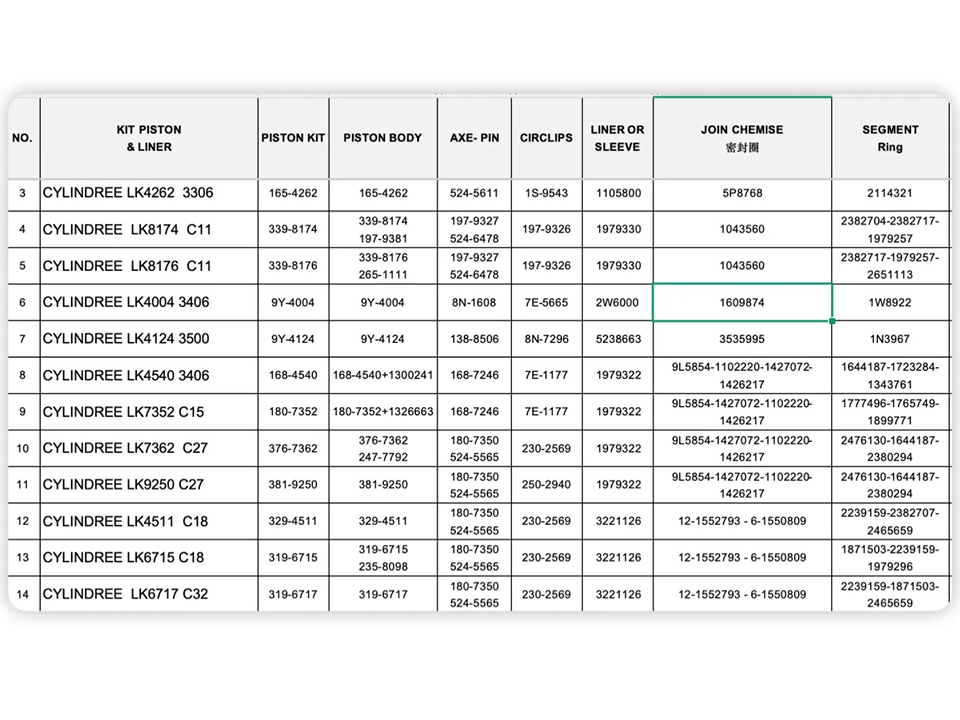
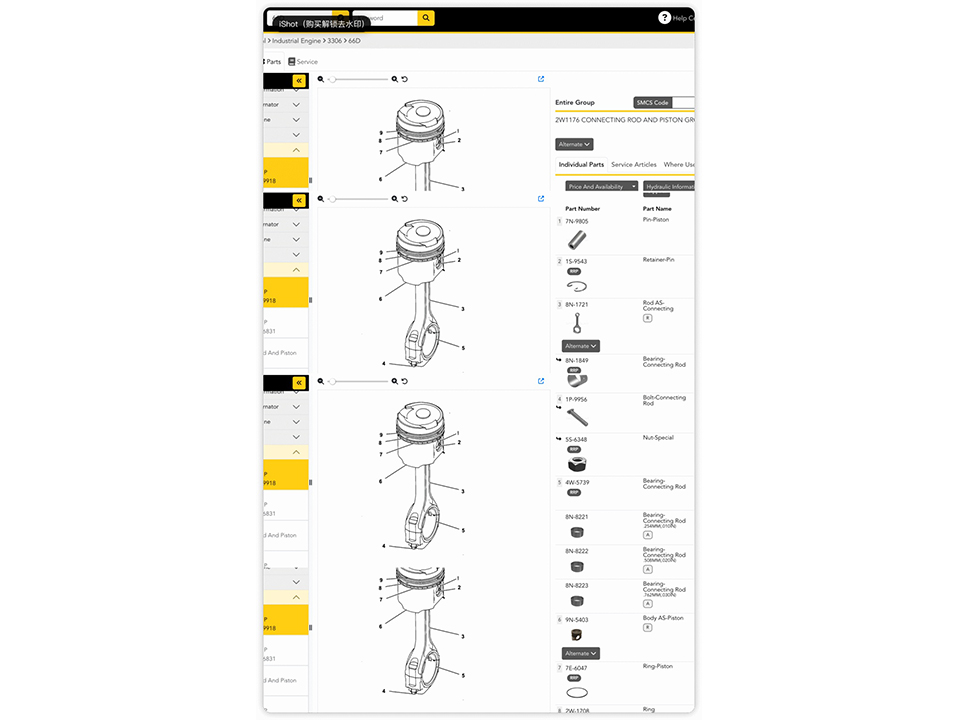
Because the phrase is useful for SEO, useful for catalog browsing, useful for getting an inquiry started. But it is not enough to place a serious PO. Not even close. A proper CAT 3304/3306 piston match lives in the weeds—part-number history, serial prefix, arrangement, crown bowl shape, compression height, wrist-pin diameter, ring-groove profile, skirt finish, coating behavior, and whether the quoted kit is really one fixed build or just a loose bundle assembled from whatever was on the shelf that week.
I’ve seen this movie before. The seller says “compatible.” The buyer hears “safe.” Those two words are not twins.
And this is where I separate real suppliers from box-movers. A real CAT 3304/3306 piston supplier usually slows the deal down at the start. They ask for the old piston number. They want engine photos. They ask if you need a bare piston, a CAT 3304 piston kit, or a CAT 3306 piston kit with matched pins and retainers. They don’t bluff through supersessions. They don’t say “all same.” They ask annoying questions because they know the cost of not asking them.
Good suppliers show discipline outside the piston line too
That pattern matters.
I don’t judge a supplier only by the piston they’re trying to sell me. I look sideways. Can they keep adjacent engine-part applications clean, or is the whole catalog one giant compatibility soup? If a seller can speak precisely about a CAT diesel engine injector 7E3348, a Perkins 4326658 fuel filter replacement, and a Perkins SE429 fuel filter for 4016 diesel engine, I pay attention. That usually means their back-office catalog control isn’t held together with guesswork and caffeine.
Yet the opposite shows up fast too.
You’ll notice it in the sloppy cross-reference sheet. Or the way bare piston specs magically “match” the kit version without any explanation about ring vendor, pin hardness, or retainer source. Or the way the salesperson keeps changing the answer after “checking with factory.” That’s not factory verification. That’s scramble mode.
OEM replacement and aftermarket aren’t the real dividing line
This one annoys people.
An OEM replacement piston for CAT 3304/3306 can be overpriced and lazy. An aftermarket CAT 3304/3306 piston can be dependable. I’ve seen both. The real split is not branding; it’s process control. Batch control. Inspection discipline. Claim handling. Boring stuff. Important stuff.
From my experience, the aftermarket fails when the seller can’t explain the metal, the machining window, the groove inspection points, the coating consistency, or the ring-pack match. They’ll say the parts are “high quality” or “export standard” or “tested before delivery”—all the usual trade-show perfume. But ask for measured pin-bore data and the room gets quiet.
And I don’t trust a supplier who can’t keep close variants straight in related product families. A seller who cleanly separates a Perkins 26510342 air filter for 1104 engines from a Perkins 26510380 air filter for 1104C diesel engines is telling me something valuable: they understand application drift. That matters when you’re trying to choose the correct CAT 3304/3306 piston and not just fill a carton.
What I want before I send money
Proof first.
Not a glossy PDF. Not “dear friend, best quality.” Not a label mock-up that hides the lot code. I want the exact quoted part number, the known supersessions, the engine/application basis for the match, dimensional checkpoints, batch identification, and a written claim process that doesn’t mutate after payment.
Because once the deposit goes out, leverage drops. Fast.
Here’s the screening table I’d use before approving any CAT 3304/3306 piston order for import, wholesale distribution, or dealer stock.
Checkpoint
Why I care
Minimum acceptable proof
Reject if
Exact application match
Engine family alone is too broad
Old part number, engine serial/arrangement data, application cross-check
Supplier relies only on “3304/3306” label
Crown and combustion design
Wrong bowl profile can hurt performance and durability
Clear crown photos, drawing, or dimensional confirmation
Supplier avoids crown-detail questions
Compression height and pin fit
Near-fit parts create expensive failures fast
Inspection report for key dimensions and tolerance range
No measured data, only nominal claims
Ring groove and ring pack match
Ring mismatch drives oil consumption and sealing issues
Groove measurements plus matched ring-set spec
Rings sold as generic add-on
Material and skirt treatment
Coating and alloy quality affect wear behavior
Batch info, material statement, process summary
Supplier cannot state alloy/coating basics
Traceability
Claims without batch traceability are dead on arrival
Batch/lot coding, carton labels, retention record
No lot control or mixed packaging
Pre-shipment QC
Good sellers inspect; bad sellers assume
Photos, inspection sheet, carton-by-carton count
“We check before shipping” with no records
Claim policy
Cheap parts become expensive under dispute
Written warranty terms, response window, evidence requirements
Policy is verbal or constantly changing
The red flags are usually boring
That’s why people miss them.
A sketchy CAT 3304/3306 piston supplier rarely screams “fraud” on day one. Usually it’s quieter than that. They send cropped photos that hide the markings. They swap compatible numbers mid-thread. They can’t explain whether the CAT 3306 piston kit uses the same piston body as the CAT 3304 piston kit. They promise documents after deposit. They dodge when you ask who made the rings. Small tells. Big consequences.
And here’s another thing I’ve learned the hard way: many returns blamed on “factory defect” were really purchasing errors upstream. Somebody approved a sample without freezing the revision. Somebody allowed mixed packaging. Somebody bought the cheaper batch after validating a better one. Somebody accepted “same as last time” without checking whether “last time” even came from the same shop floor.
That’s not bad luck. That’s loose buying.
Questions I’d force every supplier to answer
Ask like an operator.
What exact part number are you quoting? What supersession chain are you using? Which dimensions are checked piece-by-piece, and which are sampled? Are the pins, rings, and retainers batch-matched or pulled from mixed stock? What evidence do you require for a warranty claim? Who pays freight if your batch is wrong?
If the answers arrive messy, delayed, or half-translated into marketing fluff, I’m already leaning no.
I’d also freeze one approved sample, one approved carton, and one approved label. No silent substitutions. No “minor update.” No switching the ring source because the cheaper one became available the week after the trial order. That kind of monkey business is common in the trade—and it wrecks dealer trust faster than almost anything else.
FAQs
How do I choose the correct CAT 3304/3306 piston?
The correct CAT 3304/3306 piston is the unit whose part number, crown design, compression height, pin specification, ring groove geometry, and application history match the exact engine arrangement or serial-linked configuration, not merely the base engine family shown in a catalog title.
After that, I check the unglamorous stuff: batch code, inspection sheet, kit consistency, and written warranty terms. That’s where good buying gets separated from optimistic buying.
Is a CAT 3304/3306 piston the same for every 3304 or 3306 engine?
No, a CAT 3304/3306 piston is not a universal component because engines within the same family can differ by arrangement, production revision, application, combustion design, ring package, and superseded part history, which means family-level compatibility claims are often commercially convenient but technically sloppy.
So when a seller says “universal fit,” I don’t relax—I get suspicious. Usually for good reason.
What documents should a CAT 3304/3306 piston supplier provide?
A reliable CAT 3304/3306 piston supplier should provide application confirmation, part-number cross-reference, batch or lot traceability, dimensional inspection records, packing-list consistency, and written warranty terms so the buyer can verify fit, control substitutions, and defend a later claim with evidence instead of guesswork.
I also want real shipment photos with visible marks and labels. Not studio shots. Not recycled catalog art.
Is aftermarket CAT 3304/3306 piston stock safe to import and resell?
Yes, aftermarket CAT 3304/3306 piston stock can be safe to import and resell when the supplier proves dimensional control, material consistency, batch traceability, and stable claims handling, but it becomes risky when the sale is built on vague compatibility language, mixed-kit substitutions, or undocumented quality claims.
I’m not anti-aftermarket at all. I’m anti-fuzzy sourcing. Those are very different positions.
If you’re sourcing CAT 3304/3306 piston stock for resale, act like a buyer with something to lose—because you do. Push every supplier until the answers get specific, measurable, and slightly uncomfortable. The ones who stay calm under that pressure? Start there.