“The supplier gave us a true one-stop parts solution. Their team matched the right Caterpillar, Perkins, and filter parts for our equipment, and the support stayed fast and professional from inquiry to delivery.”
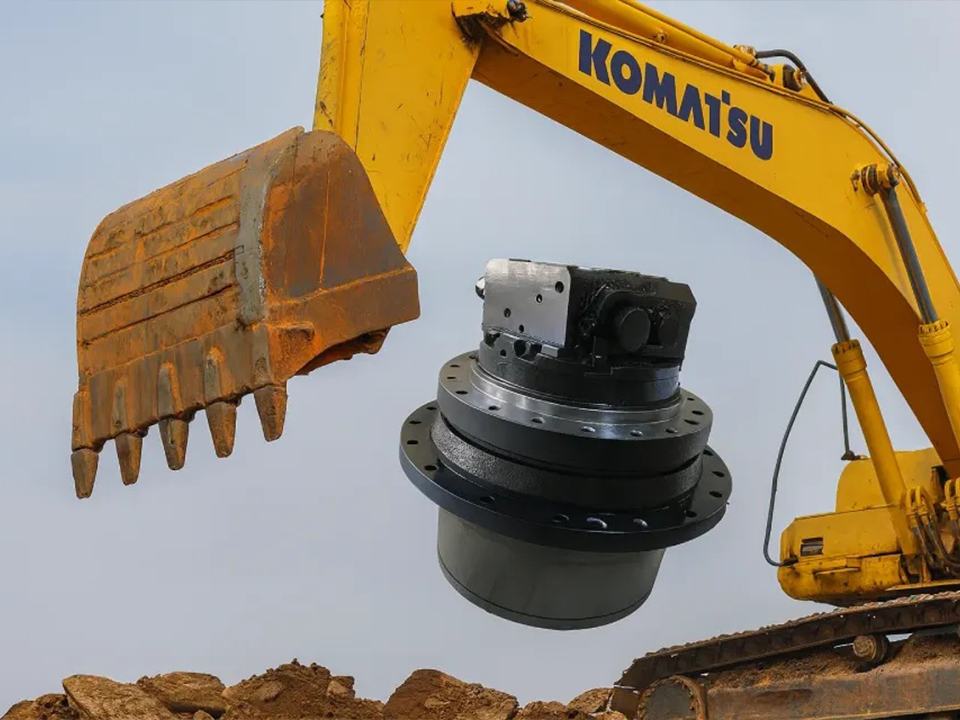
How to Identify Komatsu Travel Motor Failure Signs
Start with heat. Most operators notice the problem late because they focus on travel speed alone, while the real story has already been written in casing temperature, drain oil, one-sided pull, delayed response under load, and that ugly grinding tone that tells you hardened steel is starting to eat itself. Why do so many shops still call that “normal wear”?
I’ll say the unpopular part first: a lot of people blame the travel motor too quickly. I don’t. I’ve seen too many machines get an expensive motor quote when the actual fault sat upstream in the travel control valve, the center swivel joint, the speed-shifting solenoid, or the final drive reduction. The phrase needs a motor gets abused in this trade because it sounds decisive, and because vague diagnosis sells parts faster than disciplined testing.
And this is not academic. In a May 2024 incident summary from the NSW Resources Regulator, a haul truck lost steering after fluid escaped through a damaged hydraulic hose and the machine hit the wall of a decline; the regulator’s follow-up was blunt about inspection, testing, and competent recommissioning before equipment goes back to work.
Table of Contents
The first warning signs show up in the seat, not on the invoice
Listen harder. When a Komatsu travel motor is failing, the earliest signals are rarely dramatic; they usually show up as lazy breakout when climbing, a track that lags under counter-rotation, a machine that pulls left or right on flat ground, or a high-pitched whine that appears only when you ask for real torque.
That pattern matters. A machine that is slow on both sides can point to hydraulic supply, low system efficiency, contamination, or relief issues; a machine that is weak on one side is far more suspicious, and that is where Komatsu travel motor symptoms become diagnostic instead of generic. If one side runs hotter, leaks more case drain, and leaves metallic paste in the drain oil, I stop calling it a maybe.
I also care about how the problem changes across the shift. Cold-and-okay, hot-and-weak is a bad sign. So is a unit that travels acceptably empty but falls apart on a grade or during pivot turns. Those are classic excavator travel motor failure signs because internal leakage and worn rotating group surfaces often hide until oil temperature rises and clearances start working against you.
What Komatsu travel motor failure signs usually mean in the real world
Here is the hard truth: heat, contamination, and neglected inspection routines are not small-shop annoyances. Singapore’s 2024 workplace safety report recorded 20 construction fatalities, up from 18 in 2023, while equipment collapse or failure remained a persistent source of dangerous occurrences; that is the backdrop for every “we’ll run it one more week” decision people make around tracked plant.
I use a simple hierarchy. Abnormal noise tells me rotating parts or gears may be protesting. Abnormal heat tells me friction, bypass, or lubrication failure is already advanced. Metal in drain oil tells me the failure is no longer theoretical. Weak travel under load tells me volumetric efficiency is going away. Jerky motion or delayed release tells me brake, counterbalance, or valve behavior needs scrutiny before anyone condemns the core motor.
And no, I do not ignore leaks. OSHA’s inspection rule is explicit: repaired equipment tied to safe operation must be inspected and function-tested before reuse, and each-shift checks are supposed to catch excessive wear, contamination, hydraulic line deterioration, leakage, and improper fluid levels.If your machine is bleeding oil around the travel circuit and somebody says, “We’ll top it up later,” that is not maintenance. That is denial.
The symptoms mechanics confuse with final drive trouble
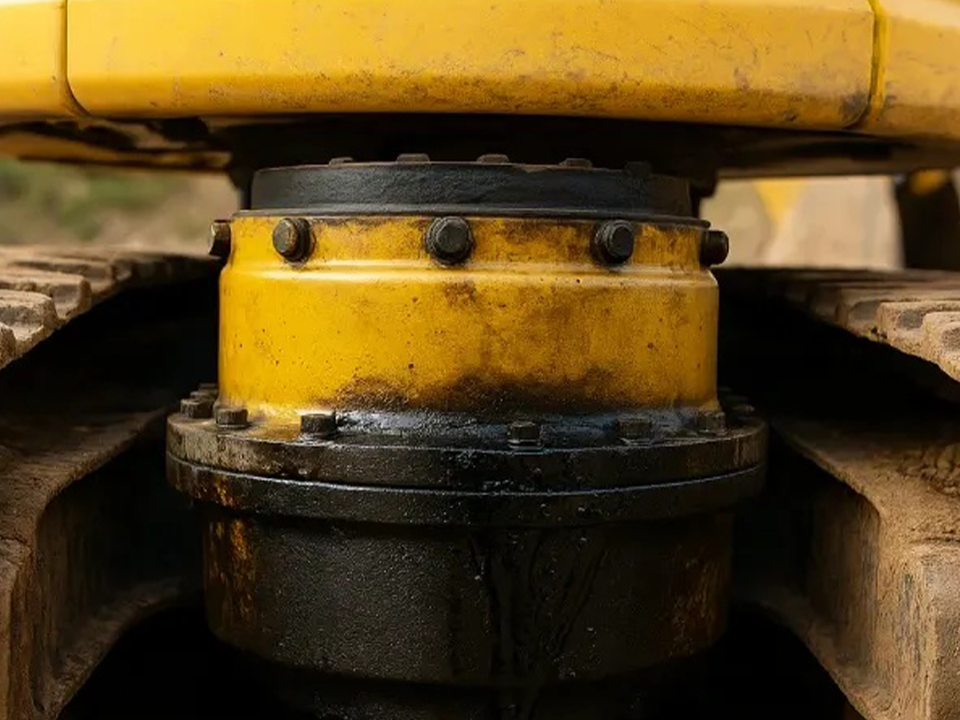
This is where money gets burned. The motor and the final drive reduction live together, fail together often enough to confuse people, and produce overlapping noise signatures, but they do not leave the same evidence if you bother to inspect properly.
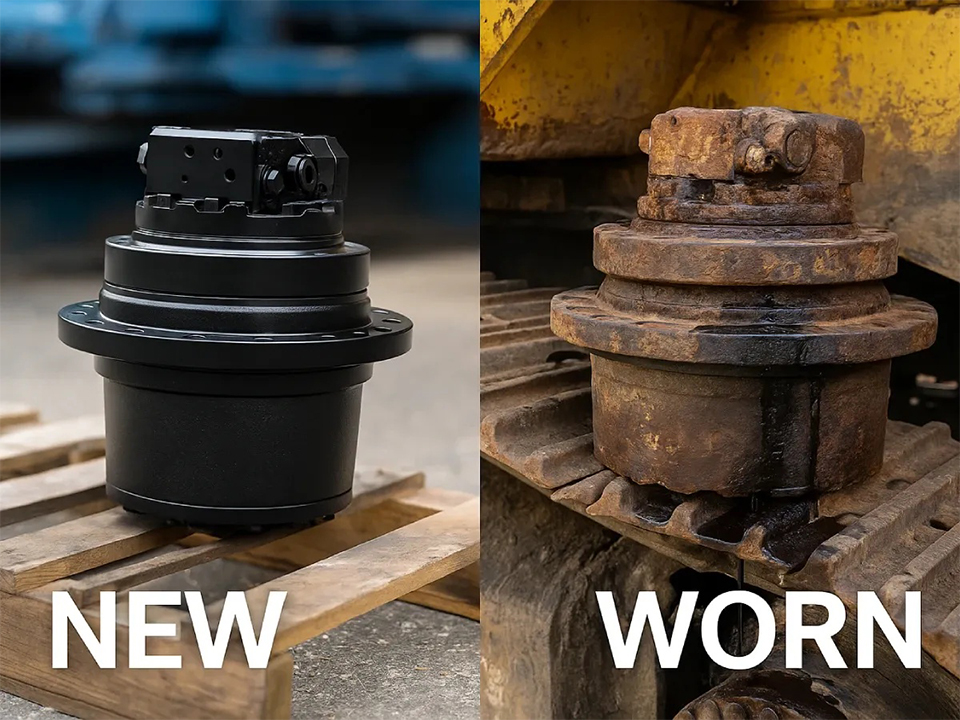
A bad travel motor usually announces itself through poor torque, excessive case drain, unstable speed change, brake-release oddities, or weakness that gets worse as oil warms up. A failing final drive, by contrast, is more likely to give you grinding from the planetary reduction, harsh knocking, contaminated gear oil, severe heat localized around the reduction housing, or a machine that moves with obvious mechanical protest even when hydraulic supply is healthy.
Need a blunt field rule? If I find abnormal sound, abnormal heating, and metal particles in the drain or reduction oil, I assume the machine has earned teardown-level attention, not another week of hopeful operation. EMESRT’s 2024 activity report made the broader point in mining fleets: excavators accounted for 14.91% of reported mobile-equipment fire incidents in its 2019-2023 data set, and hose failure was identified among the predominant causes. Hydraulic and driveline neglect does not stay neatly contained.
Weak travel motor causes that are not the motor
This section saves people money.
I have watched owners replace a travel motor when the real fault was a travel control valve spool hanging up, a center swivel seal bypassing, air entering the circuit, incorrect relief behavior, contaminated oil, or a travel speed shift problem that made the motor look lazy when it was actually stuck in the wrong operating state. That is why the phrase how to tell if a Komatsu travel motor is bad should never be answered with sound alone.
Here is my bias: I trust oil evidence over noise, temperature over guesswork, and comparative testing over shop folklore. Test the weak side against the healthy side. Compare case drain. Compare housing temperature. Check whether the failure changes in straight travel versus counter-rotation. Inspect the reduction oil separately from the hydraulic side. A real diagnosis isolates the fault path.
The inspection sequence I trust before I approve a teardown
Three passes. First, the operator pass: note pull, lag, hesitation, noise, hot-side behavior, and whether the machine worsens under grade or pivot load. Second, the fluid pass: inspect hydraulic oil condition, case drain flow, drain plugs, filters, and final drive oil for metallic contamination or burnt smell. Third, the component pass: check hoses, fittings, brake release behavior, travel control response, center swivel leakage, and the reduction housing separately.
I also want context. Did the symptoms appear after hose replacement, a contamination event, overheating, undercarriage impact, or extended travel on a job that the machine was never meant to do all day? Those details matter because failure signatures are rarely random. They are usually chained to something the machine has been trying to tell you for weeks.
And yes, people still get hurt by trying to “manage” leaks in the field instead of isolating the machine. OSHA’s 2024 President’s Report includes an incident in which a worker punctured a hand while attempting to stop a hydraulic leak on an excavator.
A working table for separating symptoms from causes
Symptom on the machine
What I suspect first
What I rule out before condemning the motor
What I check immediately
One track is weak only under load
Internal motor leakage, brake release issue, counterbalance fault
Center swivel leakage, travel control valve fault
Side-to-side temperature, case drain, brake release behavior
Machine pulls left or right on flat ground
Uneven travel motor output or hydraulic imbalance
Track tension, undercarriage drag, control linkage issue
Reduction oil, magnetic plug debris, localized heat pattern
Travel speed drops as oil warms
Internal leakage increasing with temperature
Cold-start control quirks, operator mode setting
Hot-versus-cold comparison, pressure behavior, case drain
Glitter or metal paste in oil
Advanced internal wear
Cosmetic contamination only
Drain plug, oil sample, teardown decision
I built that table the hard way. It reflects what experienced mechanics learn after enough false calls, enough cracked housings, and enough ruined gears that started as “just a little noise.”
The maintenance habits that prevent ugly failures
But prevention is never glamorous. It is oil sampling, hose inspection, filter discipline, drain-plug checks, temperature awareness, and refusing to normalize weak travel just because the machine still moves. That is not sexy copy, I know. It is also how fleets avoid turning a seal job into a motor-and-reduction assembly bill.
Heat control matters here too. If your broader maintenance program already includes cooling-system discipline, parts like a Perkins 541/427 fan belt for the 4016 diesel engine and a Perkins SE478F rocker cover gasket for the 4016 engine belong in the same conversation, because sloppy fluid management and poor thermal control rarely stay isolated to one subsystem. Machines are honest. Shops are the ones that lie to themselves.
FAQs
What are the most common Komatsu travel motor failure signs?
The most common Komatsu travel motor failure signs are one-sided weak travel, abnormal housing heat, rising case-drain flow, whining or grinding noise under load, delayed brake release, metal contamination in drain oil, and travel performance that gets worse as hydraulic oil temperature climbs. Those signs usually appear before total loss of drive. If you wait for a complete failure, you usually pay for more than the motor.
How can I tell a travel motor problem from a final drive problem?
A travel motor problem usually shows up as hydraulic weakness, unstable torque, abnormal case drain, delayed response, or performance loss that changes with oil temperature, while a final drive problem more often presents as mechanical grinding, gear oil contamination, localized reduction heat, knocking, and harsher noise even when hydraulic supply looks normal. The dividing line is evidence, not instinct. Check hydraulic-side oil and reduction-side oil separately.
Can weak travel be caused by something other than the motor?
Weak travel can absolutely be caused by faults outside the motor, including travel control valve problems, center swivel leakage, low system efficiency, blocked suction, air ingress, contaminated hydraulic oil, improper relief settings, brake-release faults, speed-shift solenoid issues, or even undercarriage drag that forces the motor to look weaker than it is. This is why side-to-side comparison matters. Weak travel is a symptom, not a diagnosis.
Should you keep running an excavator with travel motor symptoms?
Running an excavator with active travel motor symptoms means you are accepting a higher chance of internal wear, hotter operating temperatures, oil contamination, secondary final drive damage, and a sudden loss of mobility that can create a safety problem during travel, loading, or slope work. My answer is simple: no, not once metal or heat enter the picture. Park it, inspect it, and prove the fault path before it becomes a bigger bill.
If your machine is already showing Komatsu final drive failure symptoms, weak tracking, heat buildup, or metallic drain oil, stop guessing. Inspect the evidence, compare both sides, and fix the fault path early; that is how you avoid turning a manageable hydraulic issue into a full drivetrain failure and an avoidable safety event.